

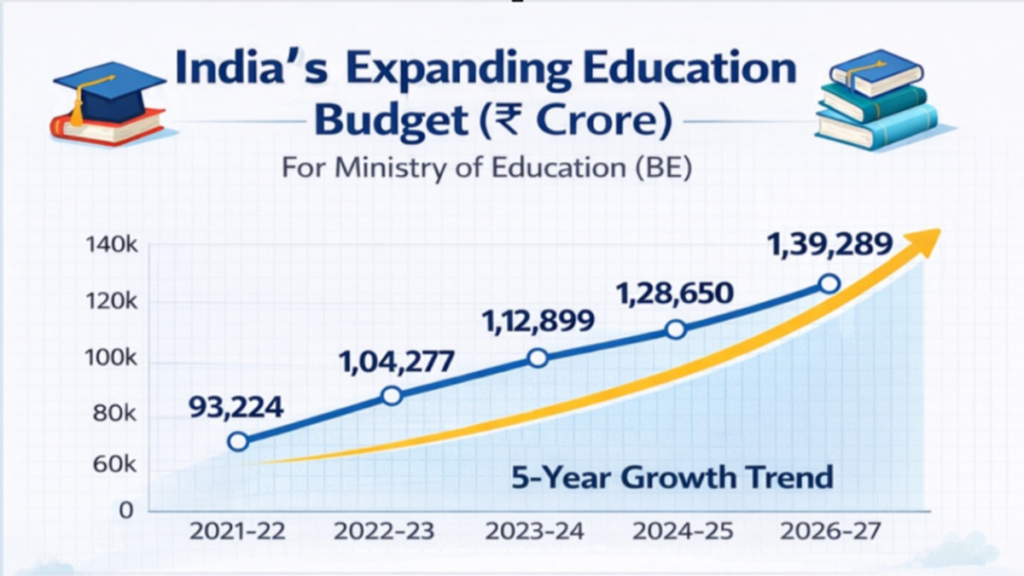
Every year, the Union Budget sparks conversations across households, but this time the focus has shifted from taxes and fuel prices to classrooms and careers. The Education Ministry Receives Record Rs 1.39 Lakh Crore Budget announcement has quickly become one of the most discussed policy decisions because education touches nearly every Indian family. From parents worried about school quality to students preparing for competitive exams, the implications are huge. The Education Ministry Receives Record Rs 1.39 Lakh Crore Budget is being seen not just as spending, but as a long-term investment in India’s future workforce. India’s education system serves more than 250 million students, making it one of the largest in the world. For years, the system struggled with overcrowded classrooms, uneven teaching standards, and a gap between education and employability. Now policymakers are signaling a shift education is no longer simply a welfare sector it is an economic priority.
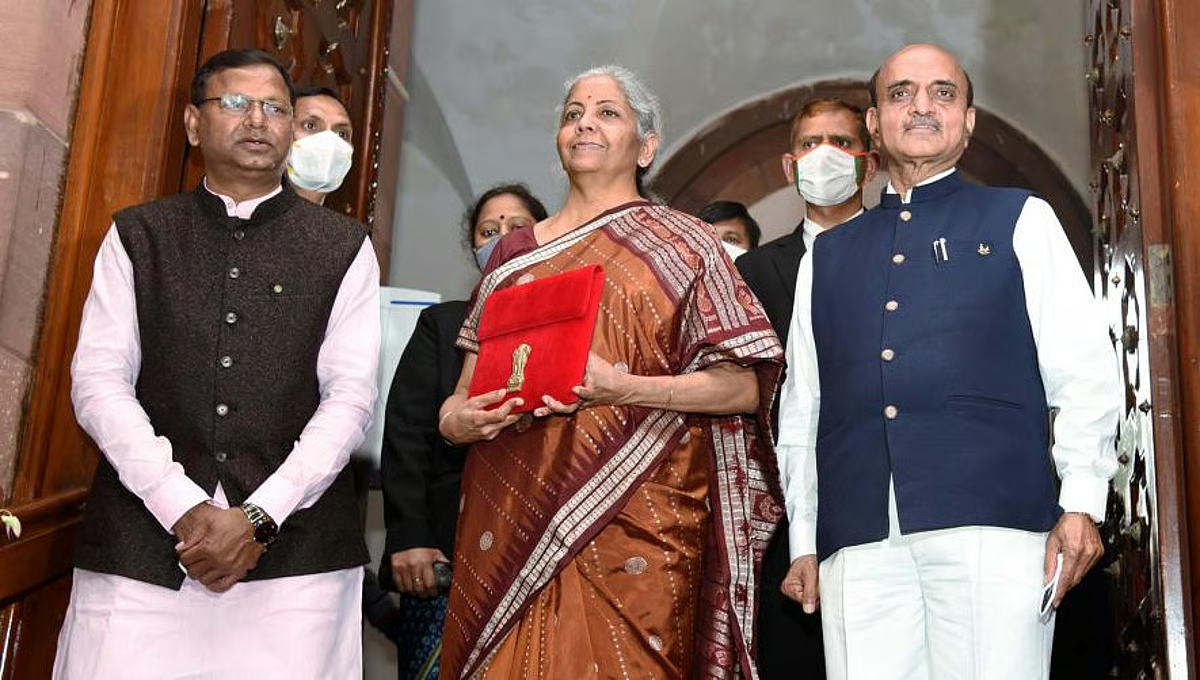
The real question is not whether the funding is large, it is whether the benefits will actually reach students sitting in government classrooms across the country. The Education Ministry Receives Record Rs 1.39 Lakh Crore Budget marks a clear change in direction for India’s education policy. The allocation strengthens school education programs, teacher development, digital learning platforms, and higher education reforms aligned with the National Education Policy. The government aims to improve learning quality rather than only enrollment numbers. By investing in infrastructure, skills, and technology, the Education Ministry Receives Record Rs 1.39 Lakh Crore Budget has the potential to influence rural schools, urban colleges, and job readiness among graduates. If implemented properly, the reform could reshape how students learn and how employers view Indian degrees.
Table of Contents
Education Ministry Receives Record Rs 1.39 Lakh Crore Budget
| Key Area & Program | Major Announcement & Funding Direction | Expected Impact & Outcome |
|---|---|---|
| Total Allocation & Policy Focus | ₹1.39 lakh crore education budget | Highest ever spending on education |
| School Education & Samagra Shiksha | Modernization of government schools | Better infrastructure & facilities |
| PM SHRI Schools & Model Institutions | Smart classrooms & laboratories | Improved quality of learning |
| Teacher Training & Certification | Professional development programs | Better teaching standards |
| Digital Learning & Online Platforms | Expansion of e-learning initiatives | Access for rural & remote students |
| Scholarships & Inclusion | Support for disadvantaged students | Higher enrollment & retention |
| Higher Education & Skill Programs | Industry-linked courses & research | Improved employability |
The Education Ministry Receives Record Rs 1.39 Lakh Crore Budget represents more than a financial announcement. It signals a policy shift that treats education as the backbone of national development. By focusing on infrastructure, teachers, technology, and skills, the plan targets the core weaknesses of the system. Whether it transforms India’s schools forever depends on execution. If funds are used efficiently and reforms reach classrooms, this could mark the beginning of a new era in Indian education. For millions of students, the coming years may determine whether education becomes a genuine pathway to opportunity rather than just a formal requirement.
Why This Budget Matters
- For decades, India focused on getting children into schools. Enrollment numbers improved, but learning quality remained inconsistent. Many students reached higher classes without mastering basic reading or arithmetic. The Education Ministry Receives Record Rs 1.39 Lakh Crore Budget attempts to address this exact problem learning outcomes.
- Education experts often point out that the first ten years of schooling shape productivity in adulthood. A country with better foundational education typically sees stronger economic growth. India is trying to move in that direction by emphasizing literacy, numeracy, and critical thinking instead of rote memorization. This funding signals that the government is not just building classrooms; it is trying to build capabilities.
Strengthening School Infrastructure
- One of the biggest areas of spending focuses on school infrastructure. Many government schools still operate without proper laboratories, libraries, or even reliable electricity. Students in rural areas often study in overcrowded rooms with limited learning resources.
- The Education Ministry Receives Record Rs 1.39 Lakh Crore Budget aims to improve these conditions through large-scale upgrades.
- Planned improvements include smart classrooms, computer and science labs, library facilities, clean drinking water, sanitation facilities, and sports spaces. These upgrades matter enormously because learning improves when students feel safe and comfortable. Clean toilets alone significantly increase attendance, especially for girls. Better infrastructure also helps teachers conduct practical lessons instead of relying solely on textbooks.
Teacher Training and Recruitment
Buildings do not teach students teachers do.
- For years, education discussions focused on infrastructure while ignoring teaching quality. This budget finally places teachers at the center of reform. The Education Ministry Receives Record Rs 1.39 Lakh Crore Budget includes structured training programs to improve teaching methods across states.
- Teachers will receive support in activity-based learning, digital classroom tools, continuous student assessment, and foundational literacy programs. The aim is to move away from lecture-style teaching toward interactive classrooms. Instead of memorizing answers, students will learn through understanding and participation.
- India still faces teacher shortages in some regions, but better training could significantly improve learning outcomes even before new hiring begins.
Push Toward Digital Education
- The pandemic revealed a major weakness in India’s education system digital access. Millions of students lost months of learning simply because they lacked smartphones or internet connections. The Education Ministry Receives Record Rs 1.39 Lakh Crore Budget directly addresses this digital divide. The government plans to expand digital education platforms and make content available through multiple formats.
- Key initiatives include online learning portals, educational television channels, mobile-based lessons, regional language learning material, and remote higher education programs. The digital university concept is particularly significant because students in smaller towns often cannot relocate to cities for college. Online degree options could provide access to quality education without migration. Digital learning will not replace schools but will support them, especially in areas where teacher availability is limited.
Focus On Higher Education and Skills
- India produces millions of graduates every year, yet employers often report a shortage of skilled candidates. Degrees alone are no longer enough in a competitive economy.
- The Education Ministry Receives Record Rs 1.39 Lakh Crore Budget therefore emphasizes skill-based education and industry partnerships. Colleges are being encouraged to offer practical learning alongside academic study.
- Expected changes include internship programs, vocational courses, entrepreneurship training, and research opportunities. The idea is simple: education should lead to employment. When students graduate with practical skills, businesses benefit and economic growth improves.
Scholarships And Inclusion
Financial barriers remain a major reason for school dropouts in India. Many students leave education not because they lack interest, but because their families cannot afford transport, books, or accommodation. The Education Ministry Receives Record Rs 1.39 Lakh Crore Budget includes expanded scholarships and support systems for disadvantaged communities. Tribal students, rural learners, and economically weaker families are expected to benefit. Support measures include scholarships, hostel facilities, transportation assistance, and learning support programs. Helping first-generation learners stay in school could significantly increase literacy and employment in the long run.
Will It Actually Transform Schools?
A large budget creates hope, but transformation depends on implementation. Past education programs sometimes struggled due to administrative delays and uneven state-level execution.
For real change, three conditions are essential:
- Funds must reach schools quickly.
- Teacher vacancies must be addressed.
- Learning outcomes must be measured honestly.
If these steps are followed, the Education Ministry Receives Record Rs 1.39 Lakh Crore Budget could become a defining reform in India’s education history.
Challenges Ahead
- Despite the optimism, challenges remain limited rural internet connectivity, uneven quality across states, administrative inefficiencies, and monitoring of fund utilization.
- Education reform takes time. The benefits of today’s investment may only become visible after a decade when current students enter the workforce.
Read More:-
Student Monthly Stipend Scheme 2026— Check List If You Are Eligible?
FAQs
1. What is the new education budget allocation?
The government has allocated ₹1.39 lakh crore to the education sector, the highest ever funding in India.
2. How will students benefit from this budget?
Students may receive better classrooms, digital learning access, improved teaching methods, and scholarship support.
3. Will rural schools see improvement?
Yes, infrastructure upgrades, digital platforms, and teacher training programs are expected to particularly benefit rural schools.
4. Does the budget support employment opportunities?
Yes, skill-based courses and internships aim to make graduates more job-ready.