
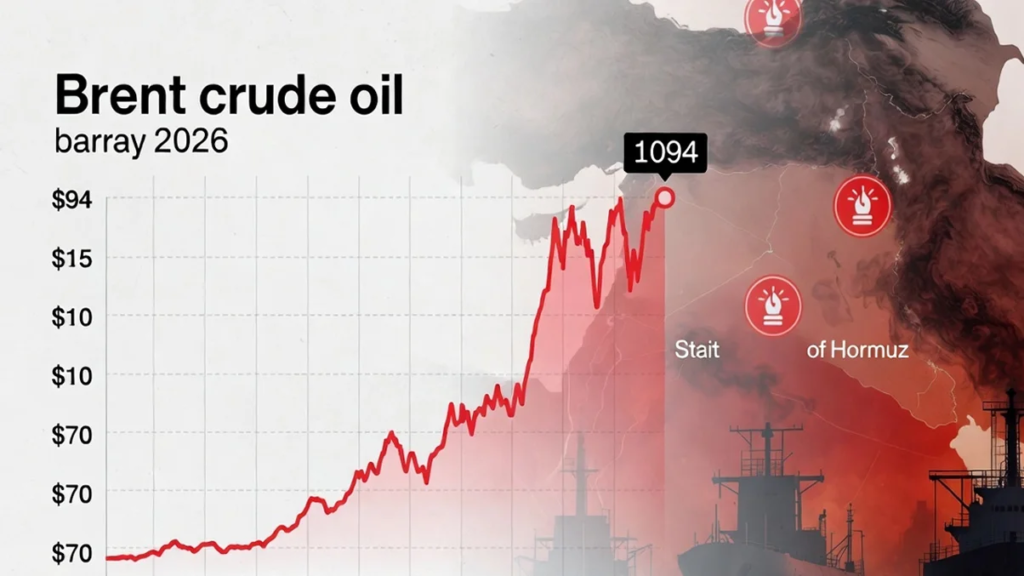
Global financial markets plummeted Monday as international crude prices rocketed past the $110 mark, fueled by an intensifying military conflict between a U.S.-Israeli coalition and Iran. The crude oil surge—marking the highest prices since 2022—follows a de facto blockade of the Strait of Hormuz, a critical chokepoint for 20% of the world’s petroleum supply.
Table of Contents
Key Market Indicators
| Asset / Index | Current Value / Price | Change from Friday Close |
| Brent Crude Oil | $114.22 / barrel | +23.2% |
| WTI Crude Oil | $110.17 / barrel | +21.2% |
| Gold (Spot) | $2,415.50 / oz | +4.1% |
| Nikkei 225 | 36,128.72 | -5.2% |
Energy Markets Hit ‘Triple Digits’ as Supply Lines Fracture
The crude oil surge triggered a fever pitch during Monday’s opening sessions. Brent crude, the international benchmark, spiked to a session high of $119.50 per barrel before settling near $114. This dramatic escalation stems from Operation Epic Fury, the joint U.S.-Israeli military campaign that began on February 28, targeting Iranian nuclear and military infrastructure.
In retaliation for the strikes, the Islamic Revolutionary Guard Corps (IRGC) has effectively halted tanker traffic through the Strait of Hormuz. Iranian officials warned that any vessel attempting to transit the narrow waterway would be “set ablaze.” Rystad Energy, an independent research firm, reports that approximately 15 million barrels of crude per day are currently stranded, unable to reach global refineries.
Global Equities Bleed Amid Inflationary Fears
The rapid rise in energy costs has triggered a massive sell-off in global equity markets. Investors are increasingly concerned that sustained high oil prices will stoke “sticky” inflation, forcing central banks like the Federal Reserve to pause planned interest rate cuts.
Asian and European Slump
Asian markets bore the brunt of the early Monday panic. Japan’s Nikkei 225 closed down 5.2%, while South Korea’s KOSPI suffered its largest single-day crash since the 2008 financial crisis. In Europe, the FTSE 100 and DAX both opened significantly in the red as energy-intensive industries braced for soaring input costs.
Supply Chain Contagion: From Semiconductors to Agriculture
The crisis is rapidly expanding beyond the energy sector, threatening global technology and food supply chains. South Korea’s Ministry of Trade issued an urgent warning to tech giants like Samsung Electronics regarding critical shortages of helium and bromine.
- Semiconductor Risk: Helium, essential for chip fabrication, is largely sourced from Qatar. With the Strait of Hormuz blocked, shipments have ceased, potentially delaying AI-server deployments.
- Food Security: Over 400,000 metric tons of basmati rice are currently trapped at ports. Approximately 75% of India’s basmati exports are destined for the Middle East, a route now deemed too high-risk for commercial insurers.
Maritime Insurance and the “No-Go” Zone
Shipping costs have spiraled as marine insurers withdraw “war risk” coverage for the Persian Gulf. According to the Lloyd’s Market Association, premiums have surged by more than 1,000% in a week.
For a standard tanker valued at $200 million, the hull war risk premium has jumped from roughly $625,000 to over $7.5 million per voyage. Major carriers, including Maersk, announced a total suspension of transits through the region on Sunday, citing “unacceptable risks to crew and cargo.”
Strategic Reserves and Political Maneuvering
Pressure is mounting on the Trump Administration to intervene. Senate leaders have called on the President to immediately tap the Strategic Petroleum Reserve (SPR) to stabilize domestic fuel prices, which hit a national average of $3.45 per gallon.
Despite the outcry, Energy Secretary Chris Wright stated that the SPR is a national security tool, not a price-management mechanism. Meanwhile, OPEC+ held an emergency meeting on March 1, agreeing to a modest production increase of 206,000 barrels per day—a volume analysts at Goldman Sachs called “insufficient” to offset the 15 million barrels blocked at Hormuz.
Cyber Warfare: The Invisible Front
Parallel to the physical conflict, a “hybrid war” has broken out. Following the joint strikes, a near-total internet blackout hit Iran. In retaliation, the IRGC-linked group CyberAv3ngers claimed responsibility for “Electronic Operations” targeting Israeli energy companies. CloudSEK, a cybersecurity firm, reported that AI-enhanced phishing attempts against global financial institutions have increased by 700% since the conflict began.
Economic Forecast: Stagflation Risks
The International Monetary Fund (IMF) has begun revising its 2026 global growth forecast downward. Economists warn that if the crude oil surge persists, global inflation could rise by an additional 1.2%, threatening stagflation—low growth coupled with high prices.
“For oil-importing economies like India and Japan, the choice is between massive fuel subsidies or letting inflation run rampant,” said Deepali Bhargava, head of Asia-Pacific research at ING. The Federal Reserve’s next meeting on March 19 is now under intense scrutiny, as the “energy tax” on consumers threatens to undo months of economic progress.
FAQ
Why is the Strait of Hormuz closure causing a crude oil surge?
The Strait is a 21-mile-wide passage for 20% of global oil. A blockade creates a “quantity shock,” where supply cannot meet demand, forcing prices upward.
How high could gas prices go?
If crude stays above $100, analysts expect U.S. gas to hit $4.00/gallon by April.
Can the Strategic Petroleum Reserve (SPR) stop the price hike?
The SPR can provide temporary relief, but it cannot replace the 15 million barrels per day lost if the Persian Gulf remains closed.