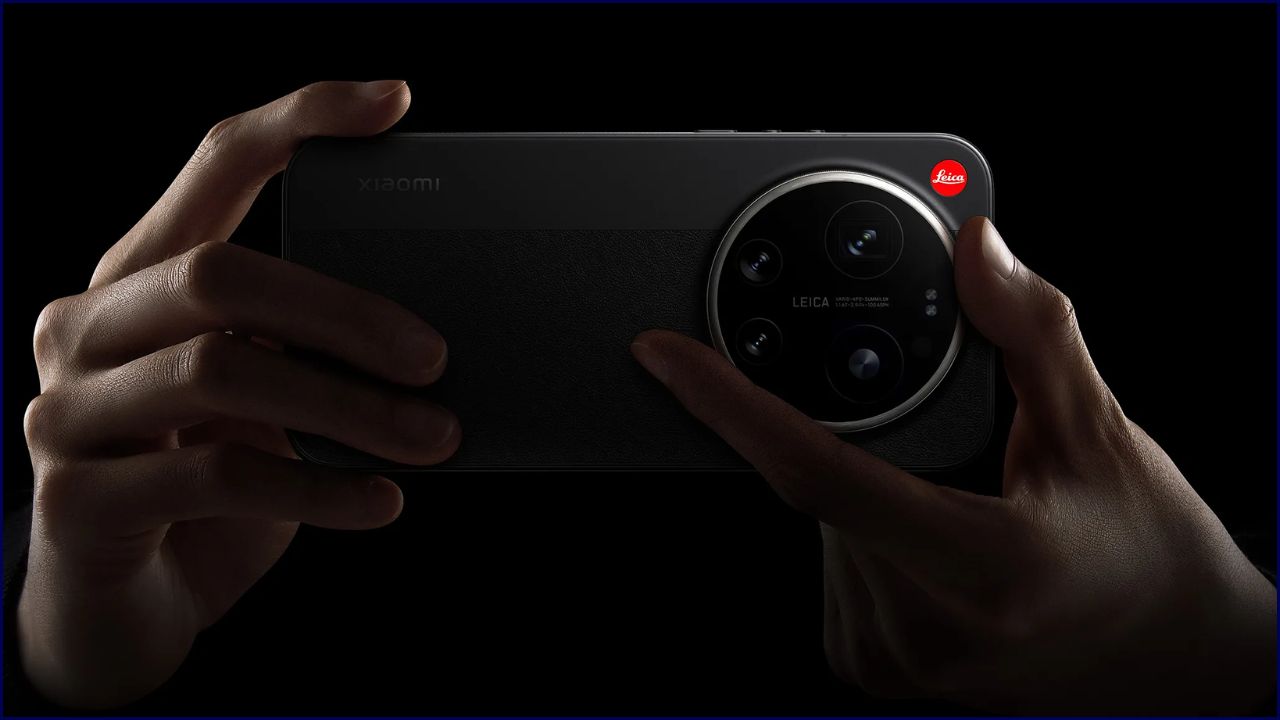

Recent Xiaomi 17 Ultra leaks have surfaced across Chinese and international regulatory databases, suggesting a significant leap in mobile imaging technology through a deepened partnership with Leica Camera AG. The upcoming flagship reportedly features a specialized 200-megapixel telephoto lens and a one-inch main sensor equipped with Lateral Overflow Integration Capacitor (LOFIC) technology. As the mobile industry reaches a plateau in raw processing power, the focus has shifted entirely toward specialized hardware that can replicate the “soul” of analog photography through advanced optics and silicon-level light management.
Table of Contents
Xiaomi 17 Ultra Leaks
| Feature | Detail | Source |
| Main Sensor | 50MP 1-inch with LOFIC Technology | Digital Chat Station |
| Telephoto Lens | 200MP APO-certified Mechanical Zoom | Xiaomi Official Press Archive |
| Processor | Snapdragon 8 Elite Gen 5 | Qualcomm Technologies |
| Display | 6.9-inch 2K 12-bit LTPO OLED | Samsung Display Corp |
Technical Analysis of the Leica Optical Breakthrough
According to reports from seasoned industry insiders, the Xiaomi 17 Ultra leaks point toward the integration of an Apochromatic (APO) telephoto lens. This certification, typically reserved for high-end professional glass like the Leica Noctilux series, ensures that the lens can focus three colors of light—red, green, and blue—onto the same plane. This alignment drastically reduces chromatic aberration, which often appears as purple or green fringing in high-contrast smartphone photos, particularly when shooting against a bright sky or reflective surfaces.
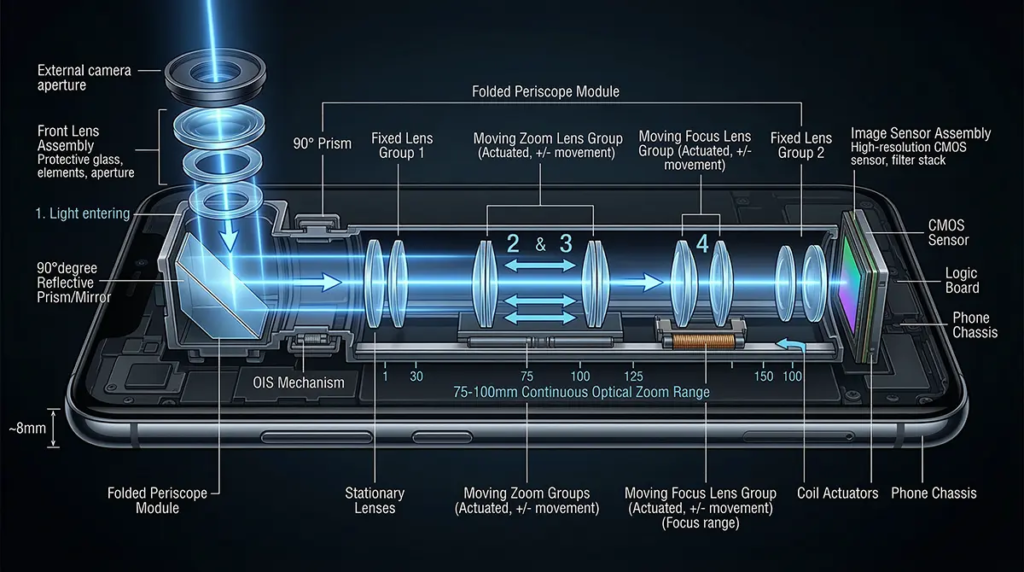
The new system reportedly utilizes a mechanical zoom structure. Unlike traditional periscope lenses that rely on digital cropping between fixed focal lengths, this hardware allows for a physical shift in lens elements. This movement enables a true optical transition between 75mm and 100mm, providing a native experience for portrait and street photography. By moving the glass itself rather than relying on software interpolation, the device preserves the natural “bokeh” and compression ratios that photographers expect from dedicated prime lenses.
LOFIC Technology and Dynamic Range Evolution
A critical component highlighted in the Xiaomi 17 Ultra leaks is the adoption of a 50-megapixel main sensor utilizing LOFIC technology. This hardware-level solution addresses the “full-well capacity” of small sensors, allowing them to handle a higher volume of light before pixels become saturated. In traditional smartphone sensors, bright areas often reach their capacity quickly, resulting in “clipped” highlights where all detail is lost to pure white.
“The goal of LOFIC is to mimic the high dynamic range of the human eye,” said Liu Dan, a senior imaging engineer who has previously consulted on mobile sensor development. By preventing highlight clipping in bright environments—such as direct sunlight—the device reportedly achieves a dynamic range of 109dB. This figure places the smartphone’s performance within the territory of dedicated mirrorless cinema cameras like the Sony A7S III. This shift marks a move away from “computational stacking,” where the phone takes multiple photos and merges them, toward a “single-shot” philosophy that feels more natural and less processed.
AI-ISP: The Silent Engine of the 17 Ultra
While the lenses capture the light, the Snapdragon 8 Elite Gen 5‘s specialized Image Signal Processor (ISP) does the heavy lifting. The Xiaomi 17 Ultra leaks suggest a new “AI-ISP” architecture that processes RAW data in real-time using neural networks. This allows the device to perform complex tasks, such as semantic segmentation (identifying hair, skin, and fabric separately), at 60 frames per second.
This processing power is vital for the rumored Ultra RAW mode, which provides 16-bit files with metadata preserved for professional editing in Adobe Lightroom or DaVinci Resolve. By offloading these calculations to a dedicated NPU (Neural Processing Unit), the phone can maintain these high-level functions without the thermal throttling that plagued previous generations.
Video Capabilities and Professional Integration
Beyond static photography, the leaks suggest that Xiaomi is targeting the professional videography market. The device is rumored to support 4K recording at 120 frames per second (fps) across its entire rear camera array. This consistency ensures that filmmakers can switch between wide and telephoto shots without losing frame rate or color fidelity—a common issue in current flagships where only the main lens supports high-speed recording.
Furthermore, the integration of the Academy Color Encoding System (ACES) Log format is expected. This standard allows editors to maintain a consistent color pipeline when mixing smartphone footage with professional rigs in post-production. With the addition of a 10-bit LOG profile and a custom Leica-tuned LUT (Look-Up Table), the Xiaomi 17 Ultra is positioning itself not just as a consumer device, but as a legitimate “B-cam” for independent film productions.
Ergonomics and the Professional Photography Kit
Design leaks indicate that the 17 Ultra will continue the “camera-first” aesthetic. The circular camera module is expected to be slightly larger than its predecessor, necessitated by the physical space required for the 1-inch sensor and the mechanical zoom motor. To balance this, the phone reportedly features a ceramic or vegan leather back for better grip.
A revamped Professional Photography Kit accessory is also mentioned in the Xiaomi 17 Ultra leaks. This grip connects via USB-C to eliminate wireless latency and includes a two-stage shutter button, a zoom lever, and a custom dial for exposure compensation. New for this year is a 67mm filter adapter ring that allows users to attach professional ND (Neutral Density) or polarizing filters directly to the phone, further blurring the line between mobile and traditional photography.
Market Position and Launch Timeline
The Xiaomi 17 Ultra leaks arrive as the company seeks to expand its footprint in the premium European and Asian markets. While Samsung Electronics and Apple Inc. continue to dominate the high-end segment in North America, Xiaomi’s aggressive push into optical hardware serves as a key differentiator. The partnership with Leica is not merely a branding exercise; it involves deep co-engineering of the lens coatings and image-processing algorithms.
Industry analysts at Canalys suggest that this focus on “Pro-sumer” features is a response to a cooling smartphone market. By targeting photography enthusiasts who are willing to pay a premium for hardware that replaces a dedicated camera, Xiaomi is insulating itself from the fluctuations in the entry-level market. The device is officially anticipated to be unveiled in late March 2026, following the initial rollout of the standard and Pro models. Pricing is anticipated to remain in the “Ultra-Premium” bracket, likely starting around $1,200 USD, reflecting the high cost of the custom Leica glass and the 200-megapixel Samsung-sourced sensor.
Competitive Landscape: Xiaomi vs. The World
As the Xiaomi 17 Ultra leaks gain traction, competitors are not standing still. The Samsung Galaxy S26 Ultra is rumored to focus on AI-driven generative editing, while the iPhone 17 Pro Max is expected to refine its “Spatial Video” for Vision Pro integration. However, Xiaomi’s strategy remains unique in its commitment to physical optical solutions over purely software-driven ones.
For the “native” audience of tech enthusiasts and digital creators, the choice is becoming clearer: Samsung for productivity, Apple for ecosystem synergy, and Xiaomi for the purest photographic experience. The 17 Ultra represents the culmination of a decade of Chinese engineering aiming to unseat the established giants through raw hardware superiority.
FAQ
What is the primary upgrade in the Xiaomi 17 Ultra camera?
The most significant upgrade is the 200MP APO-certified telephoto lens which features a mechanical optical zoom, allowing for higher clarity at varying distances between 75mm and 100mm.
What does LOFIC technology do for photos?
LOFIC technology prevents bright areas of a photo from becoming “blown out” or purely white, preserving detail in skies and lights even in difficult lighting conditions by increasing the sensor’s capacity to hold light data.
How does the 17 Ultra compare to a professional DSLR?
While a smartphone sensor is still smaller than a full-frame DSLR sensor, the 1-inch sensor and Leica optics in the 17 Ultra provide a level of depth and dynamic range that makes its photos indistinguishable from professional cameras in most social media and web-use cases.
When will the Xiaomi 17 Ultra be available?
While official dates are pending, leaks suggest a global launch event in late March 2026, with shipments starting in early April.